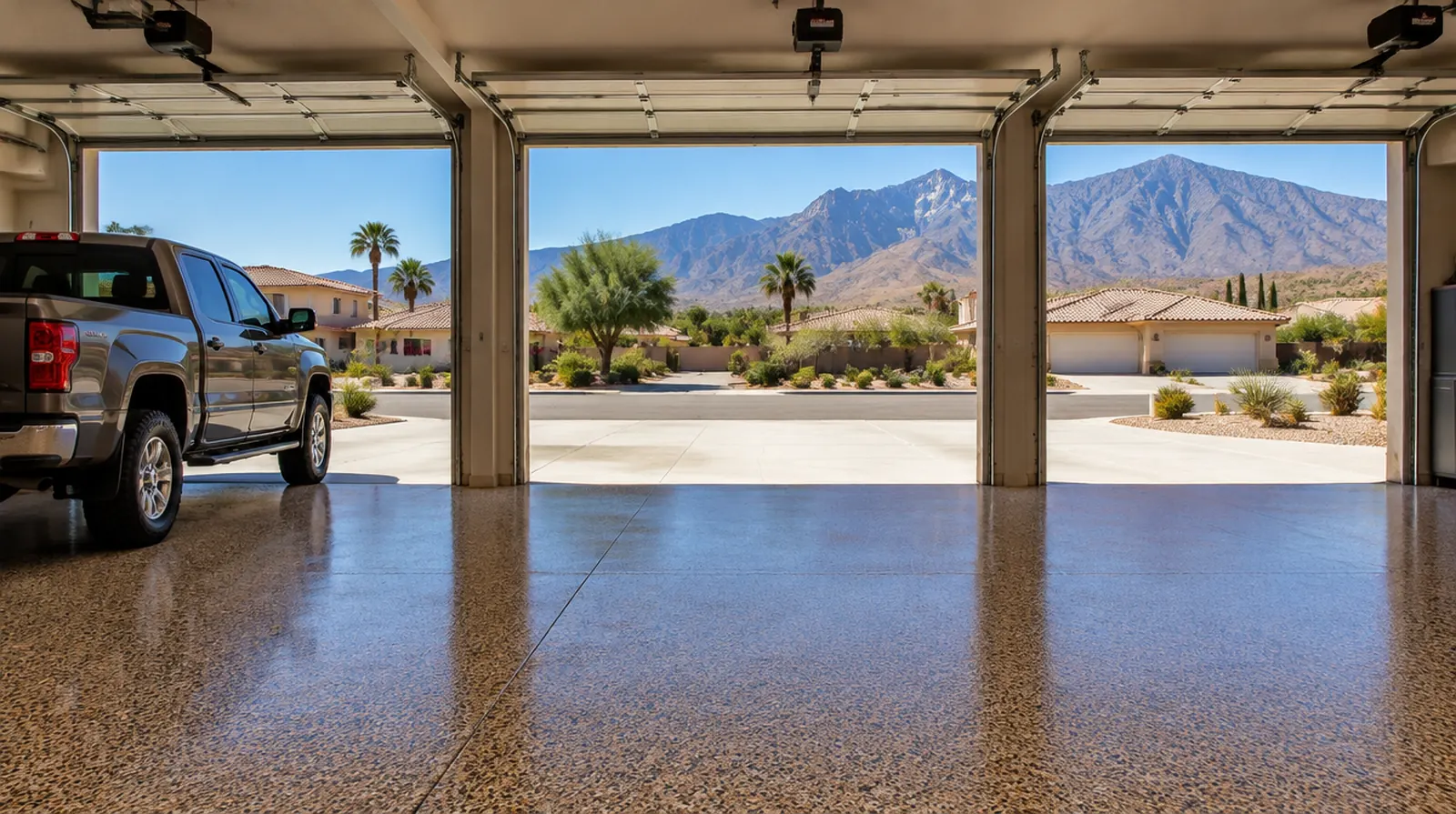
Floors for a valley town
San Jacinto sits at the foot of one of the tallest mountain ranges in Southern California, with open fields, horse properties and growing neighborhoods spread across the valley floor. Summers are long, dry and hot, often passing one hundred degrees for weeks at a time. Winter nights can drop close to freezing. Wind pushes fine dust across the valley and into every open garage. Concrete here works hard, and coatings that look fine in a mild coastal town often fail inland.
Much of the city is newer construction, with stucco homes, tile roofs and big two- and three-car garages. Those garages hold trucks, off-road toys, boats, gym equipment and long workbenches. Older parts of town have ranch homes and small shops with slabs that have seen decades of use. Both need the same thing: careful preparation and coatings rated for heat, sun and abrasion.
How a job works with us
We start with a free visit. We measure, check moisture, look for cracks and old sealers and ask how you use the space. A garage that stores a dirt bike and a trailer needs a different system than one turned into a home gym. Then we give you a written estimate listing every step, product and day of work.
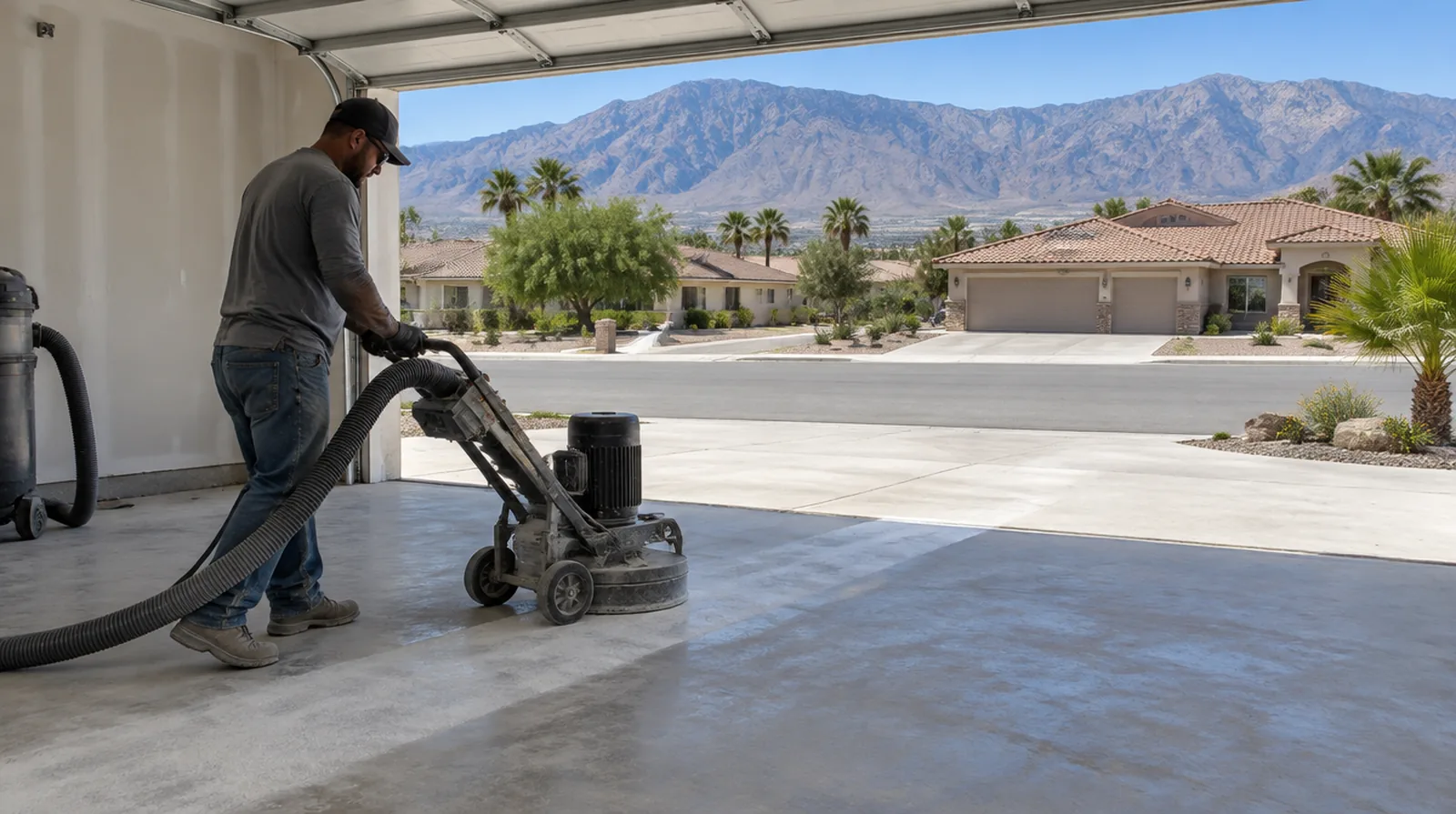
On install day we protect walls and doors, then diamond grind the slab with dust control. Grinding opens the surface and removes the builder sealer, paint or weak cream on top. We repair cracks and chips, vacuum thoroughly and apply the system. A UV-stable topcoat finishes most floors. We walk the floor with you at the end and leave written care notes.
Our services
Garages
Choose a solid-color garage floor epoxy, a full broadcast flake floor that hides valley dust or a fast-curing polyaspartic coating that stands up to sun through open doors.
Decorative interiors
Game rooms, home offices and casitas look great with metallic epoxy. Kitchens and outdoor bars get epoxy countertops.
Businesses
Shops, warehouses, ag buildings, restaurants and gyms choose commercial epoxy flooring. Offices and showrooms like polished concrete.
Outdoors and repairs
Patios and walks get concrete sealing, long drives and RV pads get driveway coatings and failing floors are fixed through epoxy floor repair.
Dust, wind and cleanup
Anyone who lives here knows how fast dust builds up in a garage. Bare concrete holds onto it, and every sweep seems to raise another cloud. A sealed, coated floor changes that. Dust sits on top and sweeps or blows out easily, and a quick damp mop leaves the surface clean. Flake floors are especially forgiving because the pattern hides fine grit between cleanings.
Heat and sun
Inland sun is intense. Ultraviolet light yellows and chalks many epoxies, and summer heat softens weak coatings so hot tires lift them. We use aliphatic topcoats that stay clear and hard, and we choose lighter colors for patios and drives so they stay cooler underfoot. On the hottest days we install in the early morning when the slab is cooler and the products behave best.
Newer homes and builder slabs
Many new homes come with smooth, hard-troweled garage slabs and a builder sealer on top. That slick surface looks clean, but coatings cannot grip it. DIY kits and rolled-on paints often peel within a year for that reason. Grinding removes the sealer and opens the pores so the coating bonds into the concrete. It is the single most important step we take.
Trucks, toys and trailers
Valley garages often hold heavy trucks, side-by-sides, dirt bikes, boats and trailers. Those bring mud, sand, fuel drips and sharp tire edges. We build thicker systems with tougher topcoats for those floors and can add extra grit where traction matters.
Questions people ask
How long does a three-car garage take?
Usually one to two days, depending on the system and repairs.
Will it handle summer heat?
Yes. We use heat-resistant systems and schedule installs around temperature.
Do I need to empty the garage?
Yes, the floor must be clear. We can suggest simple ways to stage items.
Ready for a cleaner garage? Request a free estimate.
Older homes and ranch properties
Not every slab in town is new. Older ranch homes and properties on the edges of the valley have garages, barns and shops poured decades ago, often without control joints or vapor barriers. Those floors usually carry oil stains, old paint, patched areas and long cracks from settling. They need more grinding and repair than a builder slab, but the transformation is dramatic. A stained, dusty shop can become a bright, clean space where dropped bolts are easy to find and spills wipe away.
Horse and hobby farm owners often ask about tack rooms, feed rooms and wash areas. Those spaces see water, manure, hooves and heavy carts. A textured flake or quartz system with a chemical-resistant topcoat handles that use and hoses clean. We also seal barn aisles and concrete pads to slow wear and staining.
What sets a lasting floor apart
Three things decide whether a floor lasts: preparation, material and installation conditions. We grind every floor, use industrial-grade products instead of retail kits and schedule each step around temperature and humidity. That careful approach is why our floors stay bonded through hot summers and cold winter mornings alike. Ask any installer how they handle each of those three, and you will quickly see who cuts corners.
Our promise on every job
You get a written scope before any work starts, a crew that shows up on the scheduled day and a clean site when we leave. If something looks off after the floor cures, call and we will come back to inspect it.
Book a free floor estimate
Call (951) 618-1370 for a free estimate.